

Business efficiency is not a ‘nice to have’.
If evidence were needed of the world’s current obsession with AI, look no further than Nvidia’s share price. Having cornered the market in GPUs, the chips which power most AI technologies – it controls about 90% of global demand – its shares have soared by over 150% since January 2024. This accounts for a third of the total value added to the S&P 500; over five years, the gain has been an astonishing 3,000%, even after taking a knock earlier this week.
The global AI market is set to increase 20-fold, from $100bn today to a staggering $2tn by 2030. Given that backdrop, there can be little doubt that it will have a profound effect on a great many aspects of personal and corporate life, largely in relation to the vast potential for productivity gains.
As economist Paul Krugman said: “Productivity isn’t everything but, in the long run, it is almost everything.”
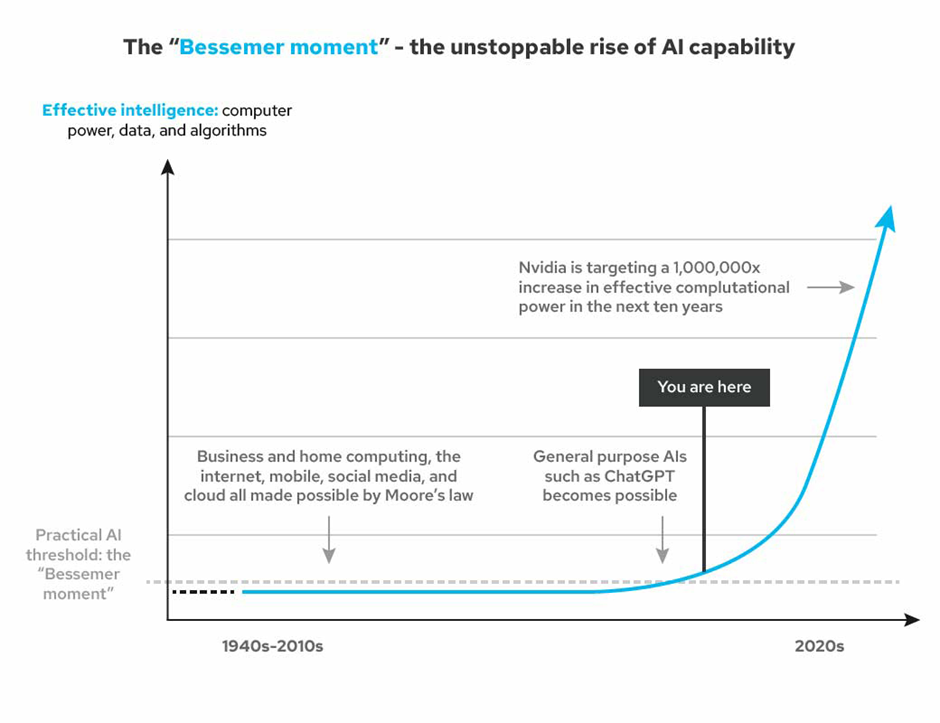
Tech specialist Ben Rogoff, manager of the investment trust Polar Capital Technology, describes it as a ‘Bessemer moment’, a reference to Henry Bessemer who, in the mid-1800s, invented a considerably more efficient, and hence less costly, method of steel production. This markedly reduced the cost of manufacturing railway track, such that vast swaths of countryside were rendered commercially accessible to providers of commodities – the genesis of the consumer society.
Despite the importance of productivity as the bedrock of economic prosperity, a paradox remains: widespread advances in, and adoption of, digital technology over recent decades have done little to alter the global growth trajectory, a phenomenon not lost on the asset management industry.
Boston Consulting Group (BCG) recently published a report indicating that total fund management AUM reached nearly $120tn in 2023, a 12% increase on the previous year. However, with revenue growth a minimal 0.2% and costs rising by 4.3%, profits declined by 8.1%.
In an intensified competitive landscape, one in six asset management firms may have disappeared by 2027, if you believe PwC.
Internally, the greatest challenge for asset managers is enhancing productivity, which is hindered by uninspiring technology implementations and the ever-growing regulatory burden. Despite the potential for AI to drive efficiencies, BCG reports that 73% of asset managers have made no meaningful progress on upskilling their workforce, and 84% have made no or minimal progress on advanced data architectures.
Much like the global productivity problem, the asset management industry is struggling with ‘bang for buck’ and, in our experience, the vast majority of firms are ill-prepared for what may come.
The good news is the industry possesses some key characteristics which make it particularly well-suited to exploit AI innovation:
- Skills: With its global reach, and a knowledge-rich workforce, the industry attracts professionals with high research, quant and IT skills who are well versed in navigating complex information landscapes.
- Data. The combination of proprietary data, tacit knowledge, investment expertise and access creates a fertile ground for AI to unlock competitive advantages.
- The personal and the personnel: Unique workflows, high-stakes decision-making and the importance of personalisation align well with AI’s capabilities in exploratory analysis, predictive modelling and customisation.
- Risk management. The pre-existing risk management culture, regulatory requirements and experience in fraud detection and prevention make the investment industry an ideal substrate for AI-driven solutions.
- Early adopters. The adoption of algorithmic trading, robo-advisory services and tokenisation highlights the industry’s readiness to embrace so-called ‘deep tech’ and drive innovation in investment management, client service and regulation.
AI systems are now capable of learning from huge unstructured datasets, identifying subtle patterns and generating insights that were previously beyond reach. Continued exponential growth will see the emergence of complex ‘multi-agent systems’, capable of automating vast tracts of the cognitive work carried out by humans.
Asset managers face a pressing need to adopt these technologies, not only to harness the productivity benefits but also to understand first-hand their far-reaching impacts on markets, economics, geopolitics and society. Early adopters will exploit the gap between current capabilities and wider industry uptake, gaining a competitive edge and mitigating unexpected disruption. As AI evolves, it will fundamentally alter alpha generation, risk management and investment decision-making processes.
A 10-point plan
There are 10 key themes on which all asset managers should be making progress simultaneously:

Where to focus
As AI evolves beyond simple chatbots, providing assistive tools, advanced automations and multi-agent solutions, there will be significant implications for asset managers. To navigate this new landscape successfully, asset managers must take urgent action and start experimenting immediately … but where should they focus?
Generating alpha
Research and analysis will become a task increasingly better suited to an AI with superior speed, capacity, attention span and a more repeatable process. By investing in AI-driven tools, asset managers can process data, identify patterns and generate actionable investment ideas more efficiently.
A recent CUNY School of Professional Studies paper shows that AI agents can accurately reason on the main drivers of allocation and selection effects, perform complex macro and micro attribution analyses and achieve high scores in question-answer scenarios.
This suggests that AI-driven performance attribution and investment appraisal could revolutionise the asset management industry, enabling faster, more accurate and more comprehensive analyses, ultimately leading to better investment decisions and enhanced alpha generation.
Models can cross-reference various disparate and unstructured data sources (eg news, earnings calls, financial disclosures, employee reviews) to score companies on complex topics such as ESG.
Client experience
Shifting client preferences and expectations for personalised, transparent and digitally-enabled services present challenges and opportunities; by leveraging AI technologies, firms can enhance client engagement, tailor marketing campaigns and investment solutions, and deliver superior service experiences.
Asset managers can employ AI-enhanced D2C platforms and personalisation engines to create customised investment portfolios based on individual client goals, risk tolerances and preferences.
AI-driven chatbots and virtual assistants can provide clients with 24/7 support, answering queries and offering information on investment options. However, this may not typically be the safest way to explore the potential for AI models until internal risk and monitoring capabilities are mature.
Operations
Operational challenges, such as uneven diffusion of expertise and growing regulatory burdens, hamper productivity growth. Nevertheless, the industry’s pre-existing risk management culture and the need for efficient processes make it well suited to benefit from AI-driven operational enhancements.
By automating routine tasks, streamlining workflows and optimising resource allocation, AI can help asset managers reduce costs, improve efficiency and focus on higher-value activities. AI-powered document processing, quality monitoring and trade settlement solutions can significantly reduce manual efforts and minimise errors.
Risk and regulation
Regulatory compliance and risk management are critical challenges, particularly in an environment of increasing complexity and scrutiny. However, the existing risk management culture and the need for robust compliance frameworks position the industry well to harness AI for improved risk mitigation and regulatory adherence.
AI-powered risk analytics tools can help asset managers identify, measure and monitor risks more effectively, assessing many more interconnected factors in real time, enabling quantitative and pro-active risk management and timely decision-making.
AI can also automate compliance processes, such as regulatory reporting and monitoring, ensuring accuracy and reducing the risk of non-compliance.
AI-powered risk can be turned on itself to mitigate the risk of relying on new ‘black boxes’. Specially trained models can be used to minimise the unpredictability, error-rates and improve the ‘explainability’ of more complex systems.
In summary
Asset managers are uniquely positioned to harness the power of AI but, as the industry embarks on its adoption journey, it will be crucial to keep a close eye on the broader AI landscape and the direction of travel.
The anticipated release of OpenAI’s GPT-5 and other advanced AI models could further accelerate the pace of change and open up new possibilities. The potential for GPT-5 level AI systems to achieve PhD-level capability in various domains could significantly enhance its application in complex financial analysis, research, and decision-making processes.
Moreover, the seemingly unstoppable growth in computing power, data and continued advancements in algorithmic techniques suggests that AI’s impact will be widespread.
To stay on the curve, asset management firms must act now to develop their AI capabilities, foster a culture of hybrid human-machine working and innovation and build partnerships with key players in the AI ecosystem. By embracing AI as a strategic imperative and investing in the necessary skills, technologies and processes, firms can position themselves to thrive.
The AI revolution presents a once-in-a-generation opportunity for asset managers to redefine their value proposition, enhance their competitiveness, actively shape the companies they invest in for the better and deliver superior outcomes for their clients.
Those who proactively adapt and harness the power of AI will be best positioned to navigate the challenges ahead and emerge as leaders in a new era.
The above piece was published in Citywire ahead of an upcoming white paper. To request a copy of the white paper, please e-mail us at info@fvenn.com


